Awards Rules
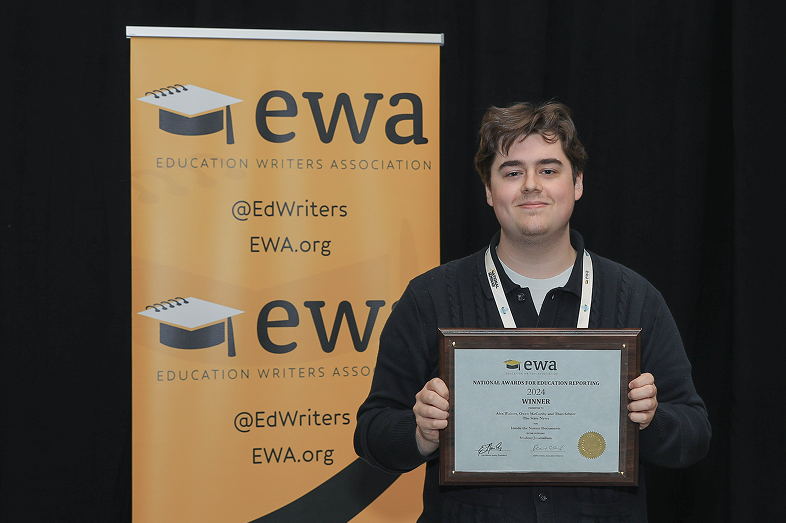
Photo credit: James Minichello for EWA
Photo credit: James Minichello for EWA
All entries must have been published, posted or broadcast in an independent news outlet for the first time in 2025, with the following exception:
Entries may not include items created by non-journalists. According to EWA Bylaws (Article II, Section 1.1), a journalist is an individual whose primary professional activity involves reporting, writing, producing, editing, or otherwise preparing the news and editorial content for independent news media. A freelancer’s primary body of work must be for independent news media. All entrants must have met these eligibility requirements at the time the entry was produced. Officers and members of the Board of Directors of the Education Writers Association may enter but are not eligible to win cash awards in the competition.
All entries must be completed by Jan. 7, 2026 at 6 p.m. Eastern. Please also note that we have a two-tiered fee structure, not including student members who pay a separate flat fee.
For 2025, EWA will accept submissions in eight categories: beat reporting; broadcast reporting; data reporting & visualization; explanatory journalism; feature, investigative reporting; podcast and student journalism. For more information, review our Categories page.
Three is the maximum number of stories in the following categories. Additionally, no more than 15 minutes of audio or video can be submitted.
Other categories:
For beat reporting, feature, investigative reporting and explanatory journalism, you must enter in one of the newsroom-size divisions. You can submit audio or visual journalism as well as online or print. If you submit a broadcast piece, choose the under 50 broadcast market or 50 and over broadcast market.
To calculate your newsroom size, count the number of all editorial “full-time equivalent” employees – including reporters, editors, designers, online producers, social media and community engagement staff and multimedia content producers, such as photographers, data analysts and videographers.
It also includes hosts, anchors, show or podcast staffers, and newsroom or programming managers and supervisors. Count the FTE during the time period the entered work was produced. If an outlet relies on part-time or contract employees, those employees should be included in the FTE count. (A half-time or quarter-time employee would count as 0.5 or 0.25 FTEs, respectively). Broadcast outlets that submit to the newsroom size categories should use under 50 broadcast market or top 50 broadcast market for their newsroom capacities.
For additional specifics, check out our Awards FAQs.
Each entry must include a cover letter that describes the entry’s development and impact, if any. Limit the cover letter to a single page.
If a password is needed to access the content, supply the necessary details in the entry form or upload PDFs of your work. If the entry contains audio or video files, we recommend uploading them to Vimeo or other password-protected sites and including the password.
Judges will disqualify any entry that does not adhere to the rules or that is submitted in a format that is difficult to read, listen to or view (broken links, PDFs in which the font is too small, a password for the paywall that doesn’t work, etc.). Please note that multimedia submissions should not be entered in the broadcast (news or features) or podcast categories. They can be entered in other categories.
Other entry criteria
If you are submitting print or digital-text stories, submit no more than three in data reporting & visualization; explanatory journalism; investigative reporting and student journalism.
Education-only news outlets
Independent education-only news outlets must submit to the education-only subcategory in beat reporting, feature, explanatory journalism and investigative reporting.
Broadcast
Broadcast, which includes television and radio reporting, now has its own category and two subcategories: news and features. The broadcast category is reserved for television and radio news organizations. Audio and visual news content that is published by non-broadcast (television and radio) news organizations is eligible to be entered in other EWA Awards categories, including feature, explanatory, investigative reporting, data reporting & visualization and beat).
Here are the requirements:
Podcast
Submit up to three education-related segments of a serialized podcast or stand-alone series centered on an education topic to give judges an understanding of what the podcast covered and examples of its creative use of audio, sound and interviews. One hour of audio may be submitted. Please note: Podcasts should contain original reporting. Please also explain any edits made for time. (EXAMPLE: Explain that you are submitting a 20-minute portion of a 40-minute podcast). Audio entries must be in the form of a URL (preferred), MP3 or WAV.
Content in other languages
Entries not originally published or broadcast in English should include English subtitles or an English translation.The translation must reflect the full content of the original work to allow a fair evaluation by the judges.
Any item submitted in one category may NOT be submitted in a second category, except as part of a beat reporting entry. A beat entry cannot include more than one story from another individual category entry. For instance, two of three stories entered into the explanatory journalism category cannot be submitted to beat.
In addition, if separate stories from a package are entered into two categories, for instance, podcast and explanatory journalism, the entries must have separate titles.
If you have produced both an audio/broadcast version of a story and a print version that is substantially similar, this would be considered “repeat content” for the purposes of the EWA Awards. If you have questions as to whether your entry might meet this threshold, please contact awards@ewa.org ahead of the contest deadline. Failure to do so risks your entry being disqualified.
Entries must be paid in full by 6 p.m. Eastern on Jan. 7, 2026 to be judged. Pay online when submitting.
EWA staff or awards judges may move an entry from one category to another if they determine it is wrongly classified. Our Category page has more specifics.
Judges reserve the right to forgo awarding prizes in categories they determine have no suitable winners. EWA may cancel a category if entries fall below 10. Refunds will be provided.
When you enter any work into EWA’s National Awards for Education Reporting, you are granting us the right to publish excerpts of and promote what you submit — photos, text, videos, etc. — on EWA’s website and through our social media platforms. We do this to highlight the caliber and importance of entries, finalists and winners.
Establishing Image Ownership
EWA Awards applicants must establish ownership of the photos included in their entries.
Please check the box that best applies:
Submitting Additional Photos
If the entry includes photos not owned by you or your outlet, please upload 1-2 additional photos EWA can use to promote your work. Photos can be headshots of yourself or images you took with your cellphone for the reporting project. Most importantly, these photos must be owned by you or your outlet and should include the photo credits in the file name.


Your post will be on the website shortly.
We will get back to you shortly