
Covering Early Childhood Special Education Amid Federal Changes
Get background on early childhood special education amid federal attempts to dismantle the U.S. Department of Education.
Photo credits: Anna Kraynova/Bigstock; James Minichello for EWA
Get background on early childhood special education amid federal attempts to dismantle the U.S. Department of Education.
Photo credits: Anna Kraynova/Bigstock; James Minichello for EWA
The world of early childhood learning can be confusing for those new to the beat, with varying types of care, funding methods, acronyms and policy changes. The field is plagued with high turnover, inconsistent availability and limited funding, despite its proven benefits for many children. Add in a special education component and it can become even tougher to cover.
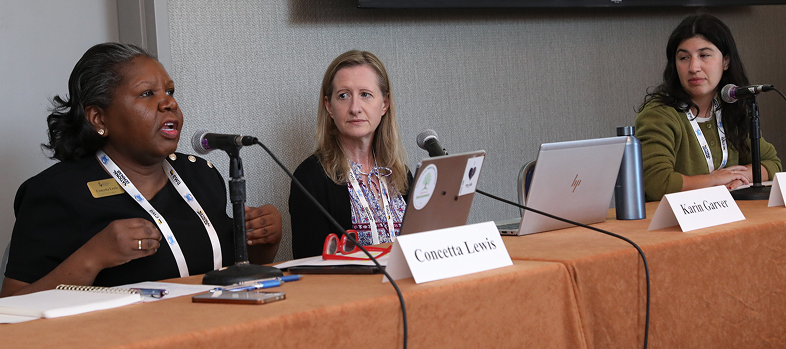
Amid ongoing federal changes to the U.S. Department of Education, speakers shared practical guidance for covering the evolving special education landscape, specifically in early childhood education. These experts spoke during the Education Writers Association’s 2026 National Seminar in early June.
Here are top takeaways, reporting tips and some story ideas to help you improve and deepen your coverage.
The 1975 Individuals with Disabilities Education Act (IDEA) is a federal law that makes a free, appropriate public education (FAPE) available to students with disabilities and ensures special education services to those children.
IDEA has remained relatively untouched by legislators on both sides of the political aisle. Many fear IDEA may eventually be gutted, or returned to the pre-1975 era, under the Trump administration.
“IDEA has not changed, and we don’t see a change in the near future where Congress is doing any reauthorization,” Concetta Lewis said. “There’s the fear they’re going to gut it and fear they’re going to add into it, so everyone’s like, ‘We’re going to leave it alone for now.’”
In mid-June, the Trump administration announced that the U.S. Department of Health and Human Services will oversee special education, sparking concerns that the focus will shift from educating students to treating their disabilities as medical conditions.
IDEA requires school districts to evaluate children who may need special education services; this is known as Child Find. It is up to each state to decide how districts will fulfill Child Find.
IDEA offers two early childhood education programs:
Here is how IDEA is funded and who provides it:
Data concerns: Collecting data on children receiving special education services is tough. Most states categorize preschoolers broadly, using “developmental delay,” which can include vision, hearing, speech, language and physical delays. The data cannot be disaggregated, making it tough to find nuance.
“It was done for the right reason, with concerns about classifying kids too young and then being labeled at a young age – specifically an autism label – but then you lose all the nuance of the data,” Karin Garver said.
Federal agency changes: The workforce reduction in the U.S. Department of Education, specifically the Office for Civil Rights, could have massive impacts. It provides information states need and oversight, and it funds technical assistance centers and monitors civil rights compliance. That reduction could have an impact in both reporting civil rights violations and collecting data.
“How will we know what student needs are if data aren’t being reported on?” Lewis said. “If there’s no data, how will we know what students show up to kindergarten? The biggest takeaway is will there be systems to support having the information to support what students need, and if we’re providing enough?”
Funding: Not all states are utilizing their funding equally to support students. Alabama, Georgia, Montana, North Carolina and Texas are all serving under 5% of children in early childhood special education programs.
“Every state does something different, so how do we ensure students are getting something solely based on where they live?” Garver said. “And ‘good’ is all relative – the states could be serving a small percentage of students but doing a nice job of including those children.”
Teacher retention issues: Like the rest of education, there is a high turnover rate of special education teachers, specifically speech and language teachers. A NIEER study found both early interventionalists and specialists were passionate about their work but had low pay, high stress, inadequate support, not enough planning time and no ongoing professional development. That can cause service delays or shortages at a critical time in a child’s life.
“Shortages cause interruptions in service for children at a critical time; this is when they are most important,” Garver said. “When [there are] delays, interruptions in service and less consistent access, it’ll have an impact on their development. And with a lot of turnover, there are also issues with families trusting those who are coming into their home or who their point of contact is.”
Lack of educator preparation: Many teachers are taught that if a student comes in and displays some sort of disability, they should be passed along to a self-contained classroom, or a classroom where one teacher stays with students for a majority of the day and separate from the majority of the school’s population.
“When a child comes in and is a little unique and doesn’t fit the mold, the teacher was taught then, ‘It’s go down the hall,” Lewis said. “We need a revamp of teacher or educator prep, so we’re starting teachers off thinking from a more inclusive setting.”
Push for self-contained classrooms: While research shows children, regardless where they fall on the disability spectrum, benefit from being together, over the last 50 years, fewer than half of preschool-aged children with disabilities are grouped with their peers.
“With speech and language delays, one of the biggest helps is to be around kids,” Garver said. “In a classroom with access to the same curriculum, with activities where therapies are being embedded in the classroom, and not yanked out then put back in. For five decades, we haven’t cracked the 50% mark, and I wish it would get more attention.”


Your post will be on the website shortly.
We will get back to you shortly