Crisis Reporting Tips From Twin Cities Journalists
Minnesota journalists explain how they navigated coverage of community crises and share tips and resources.
Photo credits: Richard Tsong-Taatarii, The Minnesota Star Tribune
Minnesota journalists explain how they navigated coverage of community crises and share tips and resources.
Photo credits: Richard Tsong-Taatarii, The Minnesota Star Tribune
Crisis reporting requires quick thinking by journalists, often in high-pressure situations. Even so, there are ways to prepare ahead of time for some of the more common challenges reporters might face before, during, and after the crisis – whether it’s an immigration crackdown by federal officials, the aftermath of a school shooting or other challenging events.
At the Education Writers Association’s 79th National Seminar last June, three journalists shared lessons from Minnesota’s Twin Cities (Minneapolis and St. Paul), where an intensified immigration crackdown became a national flashpoint earlier this year.
Moderated by Elliot Williams of The National Press Club Journalism Institute, the conversation included personal reflections from the journalists’ recent on-the-ground experiences, as well as broader discussion of tips and resources for reporters to build their own crisis reporting toolkits for the education beat.
For education reporters Becky Z. Dernbach of the Sahan Journal and Elizabeth Shockman of Minnesota Public Radio (MPR News), the surge in federal immigration enforcement in the communities they cover brought both new challenges and a renewed sense of urgency to the crucial work of local journalism.
Shockman, who covers K-12 education for MPR News, found herself relying on less-expected sources for information on immigration raids: school district superintendents. They had some of the most useful and up-to-date information about how U.S. Immigration and Customs Enforcement and U.S. Customs and Border Protection activities were playing out on, and near, local campuses. She emphasized that there’s little time, or likelihood, of building deep contacts among school staff in the midst of a crisis. The strongest sources are more likely to be the individuals already in a reporter’s contacts list.
“Superintendents had their hand on the pulse of what was happening with ICE in Minnesota, in a way that no one else in my reporting did,” Shockman said. “They’re like the mayors of small towns, where they knew exactly where ICE was, what they were doing, what was happening to kids, what resources families needed.”
Covering “Operation Metro Surge” required protecting especially vulnerable sources, as federal Border Patrol and ICE officials targeted immigrants for accelerated deportation procedures. Dernbach, whose coverage of immigrant students won a first-place prize during this year’s EWA National Awards for Education Reporting ceremony, said her newsroom is continually revisiting its standard for granting anonymity, which was a fairly common occurrence given the Sahan Journal’s focus on immigrant communities and communities of color.
Previously, if a person was undocumented, it was generally acceptable to anonymize them, Dernbach said. However, given that the immigration crackdown has expanded its reach to individuals who may be legally in the country awaiting asylum hearings, a far larger pool of potential sources now have tangible and credible fear of being deported.
As fear has spread among bystanders and activists, Dernbach interviewed a woman who helped a family at risk of deportation by ferrying their child to and from school, to reduce the parents’ risk of being caught up in a raid. The Sahan Journal editors agreed to only use the woman’s first name, to minimize the chance of her being targeted for her activism, “which I was grateful for,” Dernbach said. The news outlet is trying to “strike the new balance” between transparency on sourcing and not opening individuals up to unreasonable risk of harm, she said.
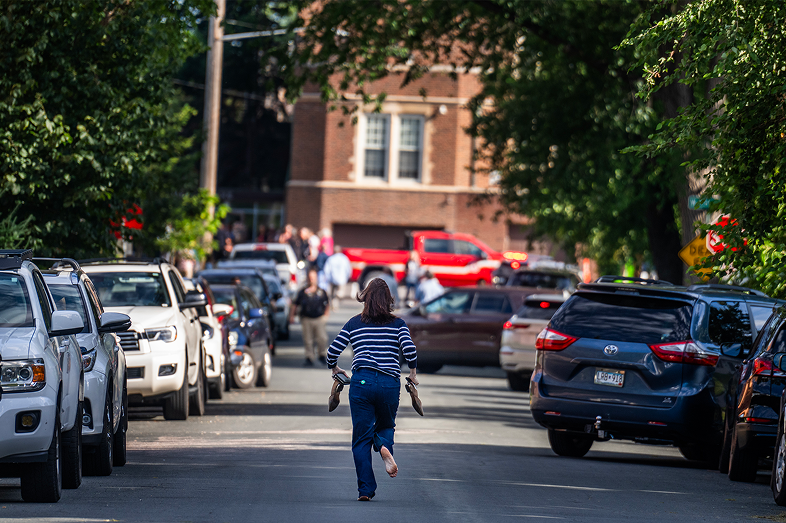
Richard Tsong-Taatarii, a photojournalist with The Minnesota Star Tribune, captured some of the heartrending fear and sorrow following a shooting involving students and staff at the Annunciation Catholic School in August 2025, just days into the new academic year in Minneapolis.
His work, which was part of the Star Tribune’s 2026 Pulitzer Prize-winning package for breaking news, included an image of a barefoot woman racing frantically toward the school, her shoes in her hand. At the woman’s request, Tsong-Taatarii has never publicly identified her. In an age when families involved in school shootings routinely report harassment and threats, if her identity became known, it could have put her at risk, Tsong-Taatarii noted.
During the recent immigration crackdown, Star Tribune photographers staked out specific neighborhoods where community volunteers were tracking activity. That gave photographers “a chance to be there to gather firsthand evidence of what was happening,” Tsong-Taatarii said. “That’s the visceral nature of photography. You have to be there at the moment. You can’t really interview your way into a picture.”
What photographers and other journalists can do, however, is take steps to protect themselves before they go on potentially hazardous assignments, he added.
Tsong-Taatarii shares his location tracking with his editors in case he’s arrested, and he turned off the facial recognition feature on his cellphone, to make it more difficult for law enforcement to access it without his permission. (For more, read about the FBI’s search and seizure of electronic devices belonging to Hannah Natanson of The Washington Post.)
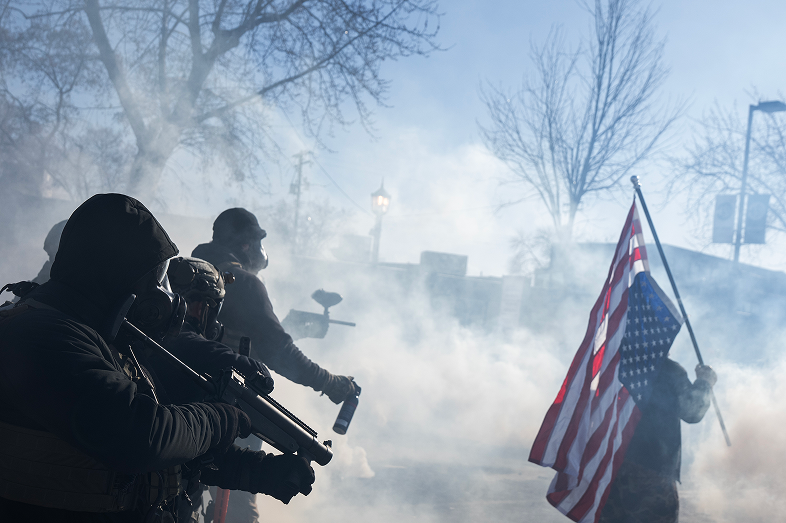
He also keeps a gas mask and other safety equipment in his car – items that came in handy when covering a raid at Roosevelt High School in Minneapolis, where teachers were pepper-sprayed by law enforcement when they tried to intervene on behalf of someone being arrested.
The three journalists encouraged reporters to be mindful of how adrenaline changes situations. It’s easier to imagine how a scenario might unfold than to always be able to follow the best practices in the moment. Remembering to eat and drink plenty of water is common sense, but it’s worth reiterating. Additionally, be prepared for an emotional crash after the crisis wanes, and don’t be afraid to ask for help – including professional counseling or other supports – from newsroom leaders.
Dernbach took part in a safety and wellness training offered by the Global Center for Journalism and Trauma for journalists in the Twin Cities. One of the takeaways was that journalists, unlike those in some other high-stress professions, can benefit from making “meaningful work out of the trauma we’re exposed to,” Dernbach said. While that might help mitigate some of the negative impact in the short term, reporters still need to protect their emotional and physical well-being, she added.
One way to prepare for the more intense events, and to be better able to decompress afterward, is to prioritize healthy habits: “Go outside; move your body; and log off(line),” Dernbach said.
Your newsroom supervisors and colleagues can also be valuable sources of support to help lighten some of the load, especially if it allows you to prioritize family time, added Shockman, who has two children. In addition to her local professional peers, Shockman said she received tremendous support from the education journalism community more broadly. Friends and colleagues, many of whom she’s met at prior EWA conferences and events, checked in during the height of the surge to offer support.
The Reporters Committee for Freedom of the Press also offers tailored support to journalists facing emergencies, said Jennifer Nelson, director of pre-publication review and reporter support for the nonprofit group. Journalists can contact the RCFP’s legal hotline at rcfp.org/hotline or 1-800-336-4243 for a referral to one of the team’s attorneys. Additionally, the RCFP’s Police, Protestors, and the Press guide has guidance for covering law enforcement.
To improve your digital safety and protect yourself from online harassment, check out this EWA blog by journalist Allie Miller. The resource includes perspectives from experts at PEN America and the Freedom of the Press Foundation. The International Women’s Media Foundation also offers training for journalists.



Your post will be on the website shortly.
We will get back to you shortly