7 Questions on Covering Hispanic Men in College
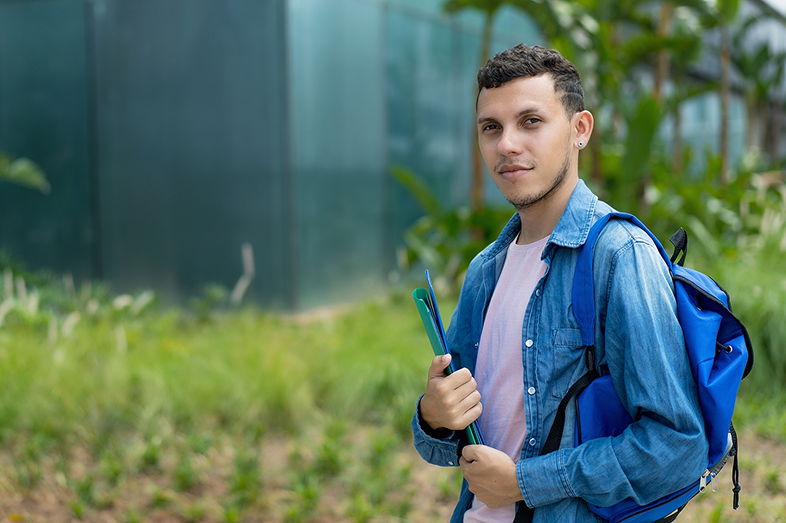
Rebecca Griesbach shares her experiences covering Hispanic and Latino men in college amid increased immigration enforcement.
Photo credit: Daniel Ernst/Bigstock
Rebecca Griesbach shares her experiences covering Hispanic and Latino men in college amid increased immigration enforcement.
Photo credit: Daniel Ernst/Bigstock
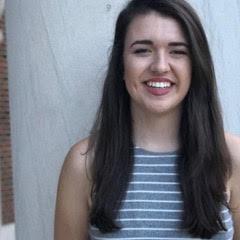
As a reporter for AL.com, Rebecca Griesbach was selected for the 19th Class of Education Writers Association Reporting Fellows in 2025.
Griesbach’s multi-part project examined efforts by bilingual college recruiters and school staff to improve postsecondary access for Hispanic and Latino students in Alabama – with a special focus on young men who come from immigrant or non English-speaking families.
Her four-part series took on a new timeliness and urgency amid the Trump administration’s ramping up of immigration enforcement in targeted communities, including in the Birmingham area, and statewide efforts to curtail diversity, equity, and inclusion programs and initiatives.
In a Q&A with EWA Public Editor Emily Richmond, Griesbach spoke about her reporting process and challenges to focusing on men of color in higher education during politically fraught times. She also shared tips for journalists.
I had written several stories about the challenges and opportunities facing communities with growing populations of immigrant families and students in the state. I felt like these stories – of teachers and lawmakers in deep-red counties advocating for English learners, for example – were powerful because they challenged assumptions about Alabama, about America, and about our shared humanity. These stories focused on K-12 schools and students, and I had always wanted to explore how these students’ journeys diverged after high school.
Despite growing supports on the K-12 side, just 2 in 5 (39%) Hispanic and Latino students in Alabama attended college the year following their high school graduation, compared to 58% of white students and 51% of Black students. Advocates I had spoken with were growing increasingly concerned about how our current political climate, marked by a storm of federal and state anti-immigration laws and policies, as well as a pause on DACA [Deferred Action for Childhood Arrivals], would impact those college-going rates even further, making it all the more important for me to tell this story at this time, and based in a place like Alabama, which has some of the nation’s harshest laws aimed at this population of students.
I wish I knew just how much sourcing this project would require – often, the students and educators featured in my stories were not the first ones I spoke with. Ultimately, I spoke with at least 30 students, and at least a dozen other advocates, researchers, and educators to better understand the nuanced impacts of the various state and federal laws and policies that were setting in at this time and creating a uniquely challenging climate for Latino students pursuing higher education in Alabama.
I encountered several challenges throughout the reporting process. I pitched this project before the [January 2025] presidential inauguration, with the hope that I would be able to follow bilingual college recruiters as they conducted home visits with high school graduates from mixed-status families who were considering college. Once I started sourcing, however, many college staff were either unable or hesitant to talk to me due to the political climate.
I originally envisioned a specific high school program and the advocate and social worker who ran it – Giovanna Hernandez-Martinez – as key components of the project. She was detained by immigration enforcement, sent to a detention facility in Louisiana, and ultimately opted to self-deport to Mexico during my fellowship. The program that she ran, and that I still planned to feature, then delayed classes, and the school district later blocked me from a visit. I was eventually able to connect with students through a few advocates who then introduced me to scores of other students and educators who helped me shape my series around other programs and student groups.
Prior to her arrest, Giovanna Hernandez-Martinez was an important source of information. She has a wealth of knowledge about state policy, and her experience working with local students helped me refine the solutions and accountability angles explored in this series.
Latino students and educators proved to be my most helpful sources throughout the reporting process.
Alexander Bautista, an educator and researcher who is quoted in the undocumented students story, brought this topic to me after reading some of my prior reporting on English learners in the state. His dissertation on the impact of HB56, Alabama’s 2011 anti-immigration law, on undocumented high schoolers in the state inspired me to pitch this project for the fellowship, and he was also a vital sounding board and connection to sources throughout the project.
Prior to her arrest, Giovanna Hernandez-Martinez was an important source of information. She has a wealth of knowledge about state policy, and her experience working with local students helped me refine the solutions and accountability angles explored in this series.
As the project evolved, I also leaned heavily on Miguel Luna, a student advocate at UAB [The University of Alabama at Birmingham], who welcomed me into his own student group and connected me with dozens of other students across the state, including the new Latino fraternity that I featured in my second story. I also greatly appreciate the students at Montevallo’s now-defunct MADE program, who courageously spoke up about the DEI law’s impact on their college journeys as policy changes on campus were unfolding, rather than after the fact.
It surprised me how willing students were to share their stories once trust was established. I sometimes catch myself censoring sources out of fear that I may be exposing them to negative attention, but I think it’s important to remember that students have agency and that their voices should be heard to the fullest extent possible. This point was underscored at an EWA National Seminar panel I attended in 2025 while working on this project, and it has stuck with me since. (The session focused on the work of the Flatwater Free Press’s Natalia Alamdari, whose profile of a Hispanic teen in Nebraska won first place in the National Awards for Education Reporting, and EWA Reporting Fellow Jo Napolitano’s investigation of discriminatory practices by public schools against immigrant students.)
There were so many, but I think the moments that stuck with me the most were the conversations I had with sources following Giovanna’s detention – especially while having to cover the news myself. As someone who has never directly or personally been impacted by these waves of mass deportations occurring across the country, it was an indescribable feeling to see this happening in real time and to know the person who was targeted. Giovanna was also such a fixture in the local community, and the news impacted almost every source I had been speaking with at the time. Deciding how – and how deeply – to cover her experience in detention added ethical challenges to my reporting process, as the news had also divided advocates, some of whom no longer trusted the organization that she worked for and that I had leaned on for information.
Explore solutions when possible. We were proud to publish these stories at a time when most coverage of Latino people in the United States (understandably) focused on crises. We thought it was important to show success stories, feature people helping each other, and help local readers understand systemic issues and possible solutions.
Rebecca Griesbach is a senior data analyst at the Cowen Institute at Tulane University.


Your post will be on the website shortly.
We will get back to you shortly