An Audio Reporter’s Notebook on Black Men in College
Lisa Kurian Philip produced a multimedia public service journalism project on the college-going experiences of Chicago’s Black men. She explains how she did the story.
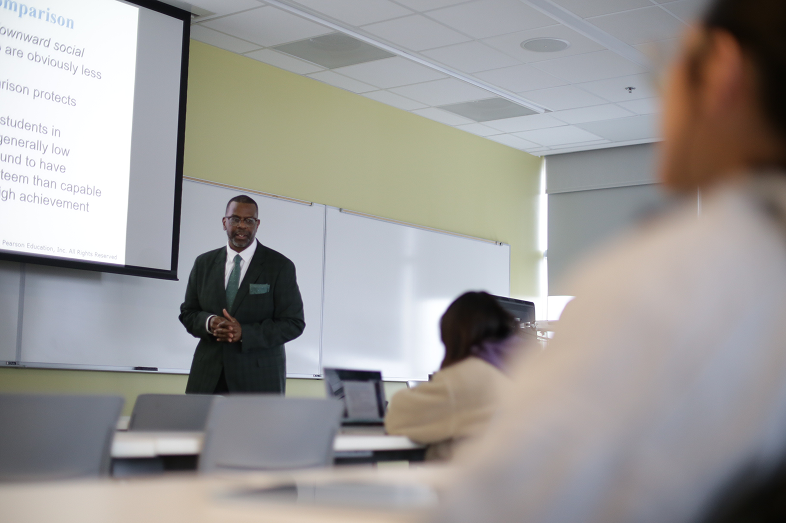
Photo credits: Lisa Kurian Philip/WBEZ Chicago (Professor and pastor Charles Brown)
But many residents – including Bernard Lilly Sr., a local pastor – believe college offers the most promising route for members of the community, harmed by decades of disinvestment and racist practices, to lift up both themselves and their families.
I met Lilly by chance at Reagan National Airport when traveling back to Chicago from the Education Writers Association’s Higher Education Seminar in Virginia in January 2023.
Lilly had been attending a youth mentoring conference to help inform his work at the College Mentoring Experience, an organization he founded in Austin to help young adults get to and through college. His nonprofit pairs high schoolers with working professionals who mentor students as they plan for life after high school graduation. My ears perked up – both because I report on Chicagoans of color and the obstacles they face on their path to higher education, and because I live near Austin.
Later that day, I looked up news coverage of the neighborhood, but I found no mention of Lilly or the College Mentoring Experience. I only found pages and pages of crime stories. From this one-dimensional coverage, it would be easy to assume that college is not even on residents’ radars. My reporting showed that could not be further from the truth.
A few months after meeting Lilly, I produced a non-narrated audio story about him and his work. But after it aired, I could not get the statistics I learned while reporting it out of my head – about how few Austin students complete a college degree. In whiter, more affluent neighborhoods in Chicago, such as Lincoln Park, 3 out of 4 students finish college.
I wanted to pull apart this data point and explore the forces behind it. The opportunity came two years later with the support of an EWA Reporting Fellowship asking recipients to produce a project on the obstacles young men of color face in getting a college degree. The fellowship allowed for months of open listening, analyzing data and forging relationships with community members – as well as a change of direction – and led to an ongoing series called the Persistence Project featuring an audio documentary, zine, and digital and radio mentorship guide.
Pivoting After Community Feedback
I started the project focused on the barriers keeping Black men in Austin from getting to college in the first place. But after months of reporting, I realized I needed to switch gears and focus on what keeps those who make it to college from finishing.
That realization followed multiple conversations in which I asked Austin community leaders why young men from the neighborhood face such an uphill battle in getting a college degree.
I explained and answered any questions people asked about my reporting project and process. I gathered hours of tape and hoped these conversations could lead me to high schoolers whom I could follow through the college application process. I planned to record their daily lives and conversations with their family members about their futures to explore their thinking around higher education and the logistics of attending college.
But time and again, community members brought up the problems that men from Austin encounter after they make it to campus, including racism, the pressure to provide for their families, and the difficulty of paying for college. They told me that awareness and support for getting students into college had increased in recent years, but after they got in, those supports fell away. Their struggles show in the data: Just 1 in 4 Black men from the neighborhood who go to college graduate within six years.
It was uncomfortable to abandon my original idea of featuring high schoolers to start over. I had spent hours talking to leaders of youth organizations from Austin and was unsure their voices would make it into the audio documentary I planned to produce.
But I also knew that these conversations informed my reporting: If I truly wanted to center the members of the community I was writing about, I needed to hear what they were saying and follow where their insights led.
Telling Audio Stories With Community
Halfway through the year and fellowship cycle, I met Charles Brown, a pastor and college professor from Austin who became a guide for my reporting. We sat down in the first pew of his storefront church, and he told me the story of how and why he took a decade to complete an associate degree – a credential that some students take two years to finish.
“Toward the end, one of the advisers told me, ‘You’ll never graduate from college … . You’re not college material,’ literally. And I was broken,” Brown told me. “Something changed from that moment on … . I didn’t want him to be right, so I made sure that I buckled down.”
Brown grew up in Austin and still lives and preaches there. Inspired by a mentor who helped him finish his bachelor’s degree, he started a mentoring program for Black and Latino men at the community college where he teaches to nurture their sense of belonging at the school and to connect them with much-needed resources. He also mentors young members of his church.
My editors and I saw in Brown’s life and work the opportunity to tell an intergenerational story about Brown, Brown’s mentor and mentee; their shared challenges in higher education, and the role that mentoring played in each of their educational journeys. This involved separate recorded interviews with each of the three men.
But it also required recording Brown preaching, teaching at his community college and, finally, meeting with his mentor and mentee for laughter and story-swapping at an Austin cafe. Capturing these moments on tape was crucial to provide texture, foster intimacy between listeners and the three men, and create enough scenes to carry a seven-minute audio narrative.
Grounding the Stories in Data
I was fortunate to have access to a wealth of data to contextualize the stories of the men I interviewed. The To&Through Project housed at the University of Chicago publishes and analyzes neighborhood-level data on the outcomes of high school graduates in Chicago, from college-going rates broken down by race and gender to the percentage of students who finish college within six years.
These data show the unique and significant barriers preventing Black men from Austin from reaching college graduation. They also challenge increasingly loud claims that programs – including those offering mentorship – meant to help Black men overcome these barriers discriminate against their non-Black peers. I made sure to ask Brown and his mentor and mentee about these claims and included context in the digital story about the Trump administration’s ongoing attacks on programs benefitting marginalized students, including Chicago Public Schools’ Black Student Success Plan.
“[There are] those who have had the intergenerational opportunity, and I don’t hate them or fault them for it, but it is a reality,” Farid Muhammad, Brown’s mentor, told me. “You can’t start a race with a 40-mile handicap and expect to somehow create equality.”
Offering Solutions and Empowering Listeners
By centering homegrown mentorship and its potential to mitigate the challenges that Black men from Austin encounter in college, I hoped the story would empower community members.
I frequently consulted with Pastor Brown – at times sending him sentences from the story and even the headline – to check that our language was not perpetuating racist narratives about Black men and the Austin neighborhood.
I turned to Brown again after my editor Kalyn Belsha had the idea to put together a how-to guide on finding and building a relationship with a mentor.
Mendy Kong, a social media producer and illustrator in our newsroom, suggested presenting the guide as a printable zine, a format that might appeal more to young adults. Kong created eight panels of illustrations, based on advice from Brown that I pared down into the simplest of steps. The zine now lives on the WBEZ website, and we are working on distributing it around the city.
We paired the zine with another audio and web guide geared toward our older, more traditional listeners and readers about becoming a mentor. The idea came from Cortez Watson Jr., who runs a mentorship organization for young Black men in Chicago.
I asked him what advice he might offer young people looking for mentors, and he turned the question around: “Why are we asking the people with the least power to figure out something?”
“Don’t ask these boys,” Watson Jr. said. “Ask the people who can show up.”
Altogether, the audio documentary, zine and mentorship guide offer reporting that not only builds awareness of the barriers Black men in Chicago face in their pursuit of higher education, but they acknowledge and amplify community efforts to alleviate these barriers. I hope to further this reporting on college persistence with the same intentional listening, use of data and public service orientation.
From the school-to-prison pipeline beginning in preschool to missed college and career readiness in middle school, learn how early childhood and K-12 education shapes college for men of color.