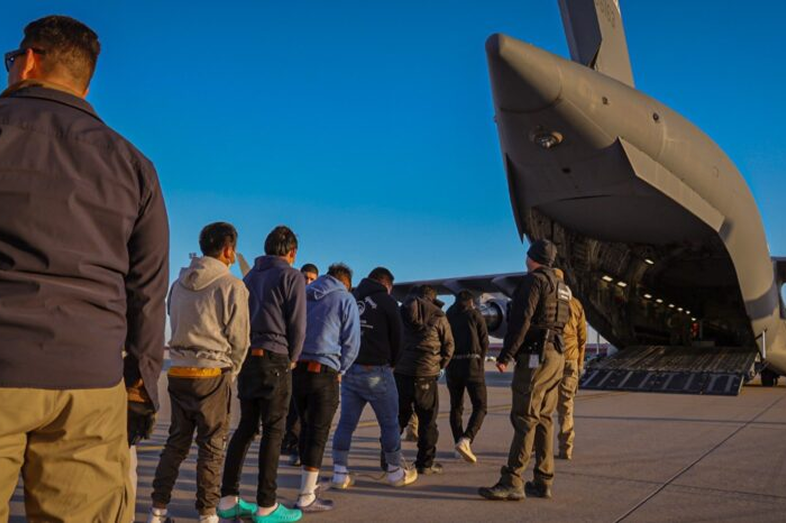
Photo caption: In January 2025, White House Press Secretary Karoline Leavitt posted this photo to the social media platform X, writing “Deportation flights have begun.”
This article was republished from The Journalist’s Resource. (Note: The author serves on the EWA board of directors.)
Two recent studies provide a first look at how schoolchildren in two of America’s largest states have been affected by the immigration crackdown President Donald Trump ordered after taking office in January. Both show student performance fell during the spring semester in parts of California and Florida as authorities began enforcing federal immigration laws much more aggressively than in prior years.
The studies also reveal a dynamic many news stories overlook: The surge in immigration raids and arrests has consequences for various student groups — not just unauthorized children or children whose parents are not authorized to be in the U.S.
“This is much broader than that,” says economist David Figlio, who cowrote one of the papers.
The first paper, published Nov. 4, 2025 in the Proceedings of the National Academy of Sciences, demonstrates that student absences spiked in southern California after the U.S. Customs and Border Patrol launched “Operation Return to Sender” at the beginning of the year.
Federal officials targeted California’s Central Valley starting Jan. 7, 2025 the day after Congress certified the results of Donald Trump’s presidential election win. Many parents in the area, a major hub for agriculture and food processing, kept their kids home from school.
Stanford University education professor Thomas Dee, who conducted the first study, estimates that students in the five Central Valley counties he examined missed an estimated 22% more days of school during the spring semester of 2025 than they had in the spring semesters of 2024 and 2023. Younger kids were absent most often. For example, the average number of days that schools reported pre-kindergarten students as being absent rose an estimated 35%.
The second paper, a working paper the National Bureau of Economic Research released Nov. 10, 2025 offers a detailed look at student performance in Florida. It examines test scores, attendance and discipline across grade levels in an unidentified Florida county that researchers describe as large, urban and home to one of the nation’s 10 biggest school districts.
A main takeaway of that analysis: Test scores dropped among middle and high school students who speak Spanish at home, the vast majority of whom are U.S. citizens. That includes children whose families are from Puerto Rico, a U.S. territory where U.S. citizenship is granted at birth, says Figlio, who coauthored the working paper with economist Umut Ozek.
As of 2022, nearly one-third of all kids living in Florida were Puerto Rican, according to a 2024 report from the National Research Center on Hispanic Children & Families, a collaboration of three universities and the nonprofit research organization Child Trends.
Schools that primarily serve students from lower-income households saw their average test scores fall farther than schools that primarily serve students from wealthier households. Girls’ scores tended to drop more than boys’ scores. Meanwhile, lower-performing students’ scores worsened more than those of higher-performing students.
Absentee rates in both states
The researchers all looked for statistically significant changes in absenteeism during the spring 2025 semester. Dee found that the average student in southern California missed about two additional days of school.
Although the youngest children were absent more often, it’s difficult to estimate the absolute number of days that students in different grade levels missed. That’s because Dee performed his analysis using the natural logarithm of the data he collected on student absences. Researchers often use natural logs when working with certain types of data to make it easier for them to apply linear regression techniques, used to construct statistical models.
Dee says schools in other parts of the U.S. may see student attendance dip as immigration enforcement increases there. He points to Charlotte, North Carolina as a recent example.
On Nov. 17, 2025, more than 30,000 kids in the Charlotte-Mecklenburg public school system were absent — three times as many students as the previous Monday, The Charlotte Observer reports. Two days earlier, masked Border Patrol agents arrived in the state’s largest city for an immigration crackdown. More than 250 people had been arrested, according to The Associated Press.
“I suspect we will see similar effects elsewhere, but I think this is an active area of research and we’re going to want to know more,” says Dee, a professor at Stanford’s Graduate School of Education and a fellow at the Stanford Institute for Economic Policy Research and the Hoover Institution, a conservative-leaning public policy think tank at Stanford.
However, Figlio and Ozek determined that absentee rates in the Florida county they studied stayed about the same after immigration authorities ramped up enforcement efforts.
How the two studies differ
Differences in the researchers’ findings could be due to several factors, including student demographics and the type of immigration enforcement each paper examines.
In the Florida county that Figlio and Ozek studied, more than 35% of public school students are Hispanic. Dee studied five California counties where more than 70% of public school students are Hispanic.
Each study looks at immigration enforcement from a different lens. Dee aimed to gauge the impact of a series of immigration raids that occurred unexpectedly in southern California in January 2025. Less than two weeks after the raids, Trump rescinded national guidelines that had been in place since 2011 to discourage law enforcement officials from enforcing immigration laws in so-called “sensitive areas” such as schools and churches.
Dee’s research shows how an unusually large increase in daily student absences across southern California coincided with four days of concentrated immigration enforcement in that region.
Figlio and Ozek, on the other hand, looked at changes in the rate of immigration arrests in Florida over a longer stretch of time. They learned that apprehension rates rose sharply after Trump’s inauguration on Jan. 20, 2025. But the number of student absences in the county they studied stayed about the same during the spring 2025 semester, explains Figlio, a professor of economics and education at the University of Rochester who is a visiting fellow at the Hoover Institution.
Florida test scores
Figlio and Ozek did find a link between immigration arrests and scores on Florida’s statewide exam, the Florida Assessment of Student Thinking, administered three times a year to students in most grades. They found that test scores dropped during the spring 2025 semester, compared to scores students received in fall 2024 and during the two prior academic years.
To better understand that relationship, they pored over data on country of origin for unauthorized immigrants who had been apprehended in Florida as well as for students in the Florida county. They show that after Trump took office, apprehension rates tripled for unauthorized immigrants across all countries of origin. But those rates increased even more for unauthorized immigrants from Guatemala, Honduras, Mexico and Nicaragua.
Figlio and Ozek created a measure they call “school-level immigration apprehension intensity,” which represents the proportion of students at each individual school who were born in the same countries as the unauthorized immigrants who had been apprehended. They discovered that test scores for Hispanic students and students who speak Spanish at home tended to drop more at schools where a larger proportion of students were born in Guatemala, Honduras, Mexico and Nicaragua, consistent with the statewide apprehension trend.
Their paper uses percentiles to describe changes in test scores. To give readers a sense of the size of the drop in test scores, they refer to the difference between Hispanic students’ and non-Hispanic white students’ scores. Historically, Hispanic students’ scores in Florida and nationwide have, on average, lagged behind those of white students who are not Hispanic.
The researchers write: “These are relatively modest effects: For example, the White-Hispanic test score gap in [this county] is 17 percentiles (so the effect on Hispanic students represents only about 3 percent of this gap) while the gap between English-speakers and Spanish-speakers is 8 percentiles (so the effect on Spanish-speakers corresponds roughly to 10 percent of this gap.”
Florida student discipline
School discipline reports also fell among Hispanic students and students who speak Spanish at home, albeit slightly. Figlio and Ozek offer two possible reasons for that.
“First, it could be due to change in student behavior: students who are more likely to be exposed to immigration apprehensions (Hispanic and Spanish-speaking students) might try to avoid getting in trouble at school,” they write. “Second, it could be due to change in educators’ attitudes towards these students: teachers and principals might be more lenient towards similar behaviors from students who experience hardships due to increased immigration enforcement. Unfortunately, due to data limitations, we are unable to disentangle these two channels.”
News reporting tips
Dee and Figlio offered three tips to help journalists report on immigration enforcement and its impact on local children.
1. Explain that missing school is a big deal for students.
Student attendance is a leading indicator of student performance. Dee stresses that it’s also a “harbinger of downstream impact,” because going to school regularly influences how much and how well kids learn and how connected they feel to their school. When kids are frequently absent, they tend to earn lower test scores and take longer to graduate high school, which can later affect their career choices and personal income.
Dee urges journalists to remind audiences that K-12 schools already are struggling to make up for learning losses during the COVID-19 pandemic. They continue to wrestle with chronic absenteeism, which worsened after COVID-19 and remains high nationwide.
“These immigration raids are complicating recovery,” Dee adds.
Absenteeism can also hurt a school’s finances. Public school funding in some states, including California, New York and Texas, is based on average daily attendance.
2. Make clear that immigration enforcement activities affect whole communities, including people who are not unauthorized immigrants.
“One thing I think our study helps bring to light is the notion that, if we are correct, there is community impact,” Figlio says.
He recommends that journalists broaden their immigration coverage by focusing on how people of various ages and backgrounds are affected by immigration enforcement. He has not yet seen news outlets report on the consequences for Puerto Rican families, for example.
As of October 2025, 65% of Hispanic voters in the U.S. disapproved of the Trump administration’s approach to immigration, a national poll the Pew Research Center conducted shows.
“Journalists have focused a large, large amount on undocumented people in the United States, and I think that’s important — but it’s a ‘yes, and … ’ [situation] as far as I’m concerned,” Figlio says. “I’d like journalists to dig in more.”
Dee recommends journalists ask teachers how immigration enforcement has affected classroom management and lesson planning. They should ask students how it has affected their classroom activities, friendships and lives outside school.
3. Familiarize yourself with the body of research on how immigration enforcement activities affect students.
Both researchers advise journalists to familiarize themselves with the research to date on how immigration enforcement in the U.S. has affected children. Figlio says journalists should not read his paper and assume they know enough to report thoroughly on the topic.
“This is the most current, most relevant data out there — but it’s still just one study,” Figlio notes.
Earlier studies can provide important insights on how immigration enforcement impacts students’ mental health and their educational attainment years into the future. Journalists should keep in mind, however, that the Trump administration’s enforcement strategies this year are much more aggressive than those of prior administrations.
A paper Dee cowrote several years ago finds that Hispanic student enrollment fell in U.S. counties where local law enforcement agencies partnered with federal agents to enforcement immigration laws under so-called ‘‘287(g)agreements.” Between 2000 to 2011, a total of about 320,000 Hispanic public school students in those counties were displaced, according to the analysis, published in 2019 in the American Educational Research Journal.
Further reading
Recent Immigration Raids Increased Student Absences
Thomas Dee. PNAS, November 2025.
The Effects of Immigration Enforcement on Student Outcomes in a New Era of Immigration Policy in the United States
David Figlio and Umut Özek. National Bureau of Economic Research working paper, November 2025.
Barriers to Success: How U.S. Newspapers Frame the Challenges of Immigrant Students in Public Education
Kerri Evans, Jiyoon Lee, Josue Rodriguez and Sarah Gawens. Social Sciences, June 2025.
Vanished Classmates: The Effects of Local Immigration Enforcement on School Enrollment
Thomas Dee and Mark Murphy. American Educational Research Journal, July 2019.
This article first appeared on The Journalist’s Resource and is republished here under a Creative Commons Attribution-NoDerivatives 4.0 International License.