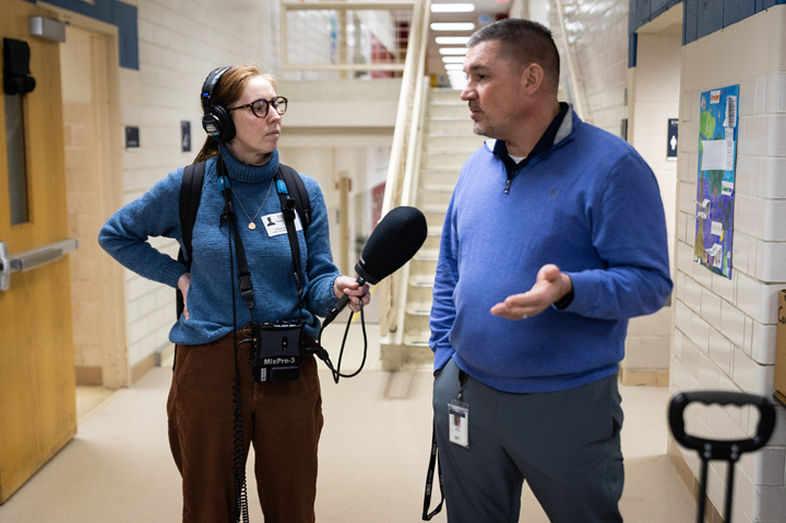
As a K-12 education reporter for Minnesota Public Radio, Elizabeth Shockman is one of many journalists who have been at the forefront of covering “Operation Metro Surge,” which recently turned Minneapolis neighborhoods into chaotic scenes of both federal immigration enforcement and resistance to it.
She spoke with the Education Writers Association about how the daily beat has changed in recent months, what she’s learned, and offered tips to other journalists covering the intersection of immigration and education.
Was there a moment when you realized the Immigration Customs and Enforcement (ICE) “surge” was going to reach a different level and scale, in terms of its impact on school communities?
Elizabeth Shockman: It was a day in early January. That day (Jan. 7), Renee Good was shot and killed by federal agents. A few hours later, Border Patrol agents were in pursuit of someone else and ended up on the lawn of a Minneapolis high school, tackling and pepper-spraying people and detaining students. My editor texted me, “You’ve got to call Roosevelt High.”
I called the principal, and I could hear screaming and whistles in the background, and he’s trying to text me videos. He tells me he just got pushed over by an agent. It’s really scary to call a principal at a school, and hear people screaming and children being hurt, and this person trying to handle it.
There was an adrenaline rush to get that first story out. I think it was later that week, either that day or the next day, I started calling a few superintendents I have a good relationship with, and the things they were telling me on the phone of what was happening to their staff and students were absolutely wild – like ICE agents arresting people, harassing staff members.
That’s when I told my editor, “This is happening … There’s something really different happening that I’ve never seen or heard before.”
There’s been tremendous reporting by many of your journalist colleagues in Minnesota on the surge and its impact. What’s that been like to be a part of that local group when the national reporters start parachuting onto your doorstep?
Shockman: Parachuting onto our doorstep and doing stories three weeks behind us – I have to just put that out there. We, of course, are following each other’s work, and other reporters have sources and expertise and experience that I don’t have, and I’m learning from them.
The education beat is very collegial, and EWA is a big part of that, frankly. Some of the relationships I have with other local education reporters in Minnesota are the result of hanging out together at lunch at EWA conferences. Over the past month, I’ve also heard from EWA colleagues I’ve gotten to know from across the country. NPR’s national education team has been particularly wonderful. I’ve been hearing from other very kind colleagues that I’ve connected with in the past and have sought help from on many things — of course, not just in this moment, but in other moments too. It’s very meaningful to feel like you’re not alone, both locally and nationally.
Your reporting on the fallout from the immigration enforcement surge often balances mundane details against these otherwise extraordinary settings.
One example is your story about the neighborhood moms who organized to help protect and support families in hiding. You start with a mother at home, making herself an egg sandwich and her kid a bowl of Lucky Charms. And then she sets off with a whistle and groceries. How deliberate is that for you?
Shockman: It’s definitely deliberate. I see myself sometimes in the people I’m interviewing – I’m a mom, and my own kid loves a Squishmallow cereal moment (laughs). I want people to get a sense of how completely insane all of this really is. I did not expect this – these students and families and educators did not expect this.
How are you managing to keep up with the other stories on your beat right now?
Shockman: The education beat, unlike some other beats, has a kind of predictable rhythm to it. There’s the academic year, with routine data releases on things like attendance and test scores. There’s also the legislative session, which in Minnesota runs from January to May, typically. You have those events and dates in mind, and you’re always building enterprise coverage around them.
Last year, I spent a lot of time reporting a story about child abuse in schools, with teachers grooming students for sexual abuse. Individuals who were girls when this abuse happened, and are now women, have taken the courageous step of not just speaking about what happened but really forcing people to look at failures by districts and different state agencies to protect them. Some of our state lawmakers responded to that reporting, and there was a lot of momentum. I’m hoping to turn back to that soon.
The other big story we’ve been covering for many years is lessons learned and ongoing recovery from COVID. There was a bipartisan effort to address attendance and literacy. In addition to asking “Has it been effective? Where is it not working?” ICE is now a component of that larger story. The disruption has thrown so many things off track. This morning, I spoke with a superintendent who said, “We were making such good progress on attendance and grades, and now hundreds of my kids are too afraid to come to school.”
What are some of the ways you’ve adjusted, not just the kinds of stories you’re covering, but also how you report?
Shockman: Our newsroom underwent training on how to keep ourselves safe when we’re out at protests, how to interact with federal agents and other law enforcement, and what to do if we’re stopped or detained. There are basic protocols to follow to protect your electronic devices – turning off location sharing and biometrics, for example. I’ve always been careful to protect my sources, but there’s an additional layer to all of that now. I’m granting sources anonymity in some cases, talking to sources in hiding through intermediaries. There are things I’m doing regularly that I wasn’t thinking about in December (2025).
The daily things that have been most helpful to me are all the regular stuff that all good education reporters are already doing all the time – cultivating sources and relationships. You need to know the people on the legislature’s Education Committees, immigration lawyers, experts in school safety, the teachers, district comms directors, principals and superintendents. You also need to know the school resource officers (SROs) who have connections to the local police departments, and the people in the state offices and licensing agencies. It’s always important to develop relationships with people who, in a time of crisis, are going to text you and pick up your calls.
With ICE reportedly drawing down its presence in Minneapolis, there have been threats by the Trump administration for similar “surges” in other cities – notably, in “blue” states. What advice do you have for other education reporters who might be looking ahead?
Shockman: I don’t care where you live and what district you’re reporting on;I think there is a spot for you to do reporting on this. Do not wait for the surge.
- Ask what your district is doing to prepare, or reach out to the Department of Homeland Security and ask what is happening and why.
- Pay attention to the language that’s being used to discuss these issues in your local school board meetings, particularly in very “red” communities.
- Look at the sources of information they’re using and relying on, and the rhetoric that’s showing up at parent-teacher organizations, in Facebook groups, and other public meetings.
It’s all part of the story.
- What are parents’ rights groups doing right now?
- Are they pushing their schools to share student data with federal immigration agencies?
- Are they worried about how ICE could affect their kids?
- Are they not talking about it? And vice-versa, what are more liberal school districts doing?
- Are any districts, whether conservative or liberal, developing partnerships with local law enforcement?
- Are they offering legal help to immigrant families?
- Are they petitioning state or national lawmakers?
- How does what’s happening in MN affect what’s happening elsewhere, if at all?
I also think schools are a particularly important way to track what ICE is doing. Many Minnesota superintendents I’ve spoken to are able to describe on a day-to-day basis exactly how ICE is affecting their community, and children in their community.
Superintendents have been some of the best on-the-ground sources of current and comprehensive information we have. They are also, in some cases, being personally targeted by – who they believe – are ICE agents.
Last week and this week (Feb. 9-18) superintendents and Parent-Teacher Organization (PTO) leaders have had some of the most tuned-in senses of whether ICE is still in Minnesota or whether ICE is changing tactics or whether ICE is leaving.