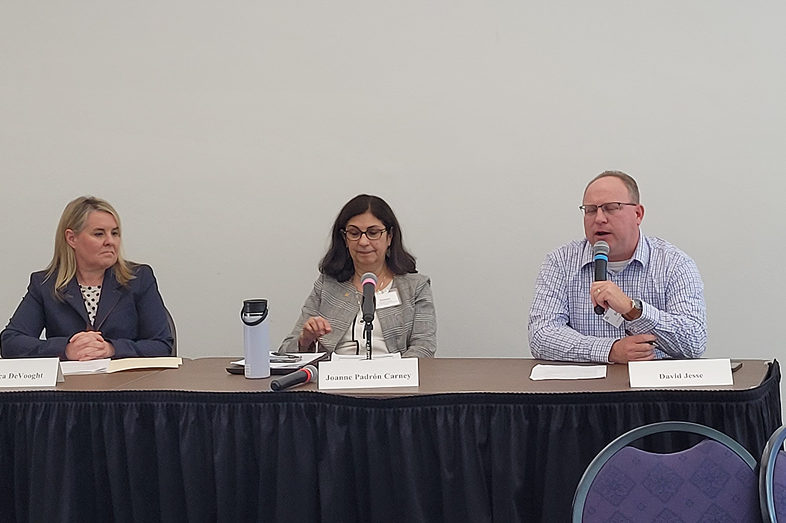
Reductions to federal research – some proposed, and others already realized – promise to reshape the relationship between “town and gown” in coming years. At the Education Writers Association’s 2025 Higher Education Seminar in September, two government relations professionals discussed how federal policy changes affect campuses and their surrounding communities.
Participants
- Joanne Padrón Carney, chief government relations officer at the American Association for the Advancement of Science
- Rebecca DeVooght, vice president for government relations at Michigan State University
- David Jesse, The Chronicle of Higher Education (moderator)
Top Takeaways
Expect research funding sources to change.
In recent years, the federal government has funded more than 50% of higher education research and development (R&D). Postsecondary institutions funded 25%, and the remainder was funded by. nonprofits, businesses, state and local governments and other sources.
Reporters should anticipate the proportions could shift: The federal government has already frozen or cut billions of dollars in grant funding across various agencies, and President Donald Trump has proposed a $42 billion reduction for non-defense R&D in 2026. The budget hasn’t yet been finalized by Congress as of December 2025.
It’s unrealistic to expect that donors and the private sector will make up lost funding at such a large scale, Padrón Carney said.
Philanthropic organizations are trying to assess how they can help, but they also need to prioritize their financial portfolios, Padrón Carney said. Private companies might kick in more dollars, too, but they have specific products or goals in mind and are unlikely to fund “research for the sake of research” – which has historically led to important scientific discoveries, Padrón Carney said.
When an institution’s research priorities change, it affects the community.
Colleges and universities are reprioritizing where they invest in research, applying for grants they believe they may win.
Institutions are also going to become more selective about which graduate students they recruit – particularly when considering students’ area of study – and what research partnerships institutions form with the community, DeVooght said.
All of those decisions will affect the work of faculty, staff and graduate students. Padrón Carney and DeVooght said the effects will trickle down into local economies as well – whether it’s because institutions are major sources of employment for smaller or mid-sized towns, or because certain research is no longer spurring economic growth or development.
Administrators are focused on showing the value of research.
Many college leaders are homing in on relationships with their surrounding communities because some lawmakers and businesses haven’t drawn the correlation between research and economic development, DeVooght said.
It is now falling on colleges to better communicate the value of their research – including by providing specific examples of the economic impacts on the wider region, she said.
Story Ideas
Dig deep at your campuses, and you’ll find an influx of stories to write about the impacts of R&D funding changes on university budgets, employment and halted community projects.
Here are some approaches:
- Policy: As climate change, public health and other issues increasingly fall to state and local governments to address, see how those entities use science to make decisions, Padrón Carney recommended. Who are they consulting? Are they working with universities? Is there a gap in expertise?
- Enrollment: Follow trends in Ph.D. enrollment and the employment of postdoctoral researchers. Are there fewer applicants? More rejections? Are scholars who want to study topics that are unpopular with the federal government opting out of academia entirely?
- Buzzwords: Through open records requests, ask postsecondary institutions for research projects paused or cut by the federal government in 2025, and ask for the grant proposals originally submitted by principal investigators. Use reporting tools to search for the words flagged by the Trump administration.
Once you have a list of research that has been paused or cut, read the abstracts (or search for the projects online) to see if any of them involve community organizations. Reach out to those organizations for stories about how they’re affected – you might find a good feature about important work that’s being lost in the community.
Reporting Tips
- Dig into the data. Economic impact reports can feel nebulous, but postsecondary institutions arrived at numbers boasting however many millions of dollars in economic impact for a reason. Communications departments should be able to help break them down specifically and help you identify community partners as potential interviewees. It’s also a good idea to check the figures with outside organizations, such as your city’s economic development arm or researchers who study the local economy.
- Relationships are key. Many institutions have become tight-lipped because they don’t want to draw attention from the federal government. Colleges and university officials are going to be more inclined to point you to needed resources if you’ve already established a level of trust.
Resources